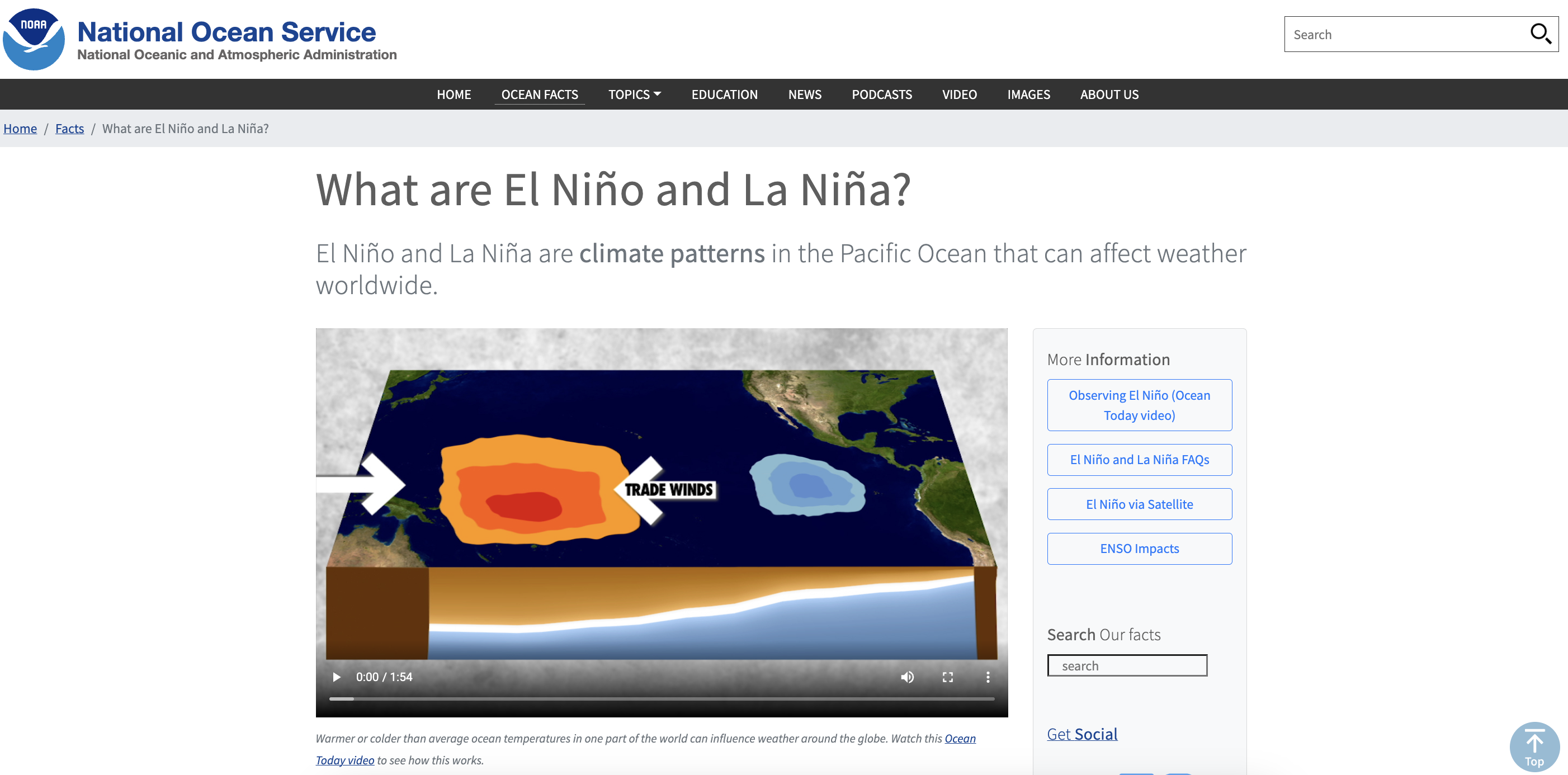
What are El Niño and La Niña?

Related Resources

Despite Pandemic Shutdowns, Carbon Dioxide and Methane Surged in 2020
Carbon dioxide levels are now higher than at anytime in the past 3.6 million years. Levels of the two most important anthropogenic greenhouse gases, carbon dioxide and methane, continued their unrelen[...]
5 “Blue Forests” That are Vital to Life on Earth
When you think of a forest, chances are you picture trees rising high above you, leaves crunching underfoot. But there are some very different types of forest – in and under the water – th[...]
The Biological Productivity of the Ocean
Productivity fuels life in the ocean, drives its chemical cycles, and lowers atmospheric carbon dioxide. Nutrient uptake and export interact with circulation to yield distinct ocean regimes. [...]
Kelp Deforestation: Threats to our Underwater Forests
Kelp forests are some of the most dynamic and ecologically productive marine habitats in the world. A root-like system called a holdfast affixes to the rocky seafloor, supporting a long stipe that ext[...]
Provisioning and Supporting Services of Mangroves
There are a number of tangible products that can be directly utilised and marketed from mangrove forests. [...]
What are Mangrove Forests?
Mangroves are shrubs and trees that grow in coastal waters. Mangroves are halophytes, meaning they are salt-tolerant trees that thrive in intertidal conditions. These diverse and productive ecosystems[...]
Why Protecting & Restoring Blue Carbon Ecosystems Matters
Mangroves and seagrass meadows are coastal ecosystems that cover a small portion of the total ocean area but collectively are widely distributed on every continent except Antarctica. Mangroves are fou[...]
2020 Was One of Three Warmest Years on Record
The year 2020 was one of the three warmest on record, and rivalled 2016 for the top spot, according to a consolidation of five leading international datasets by the World Meteorological Organization ([...]