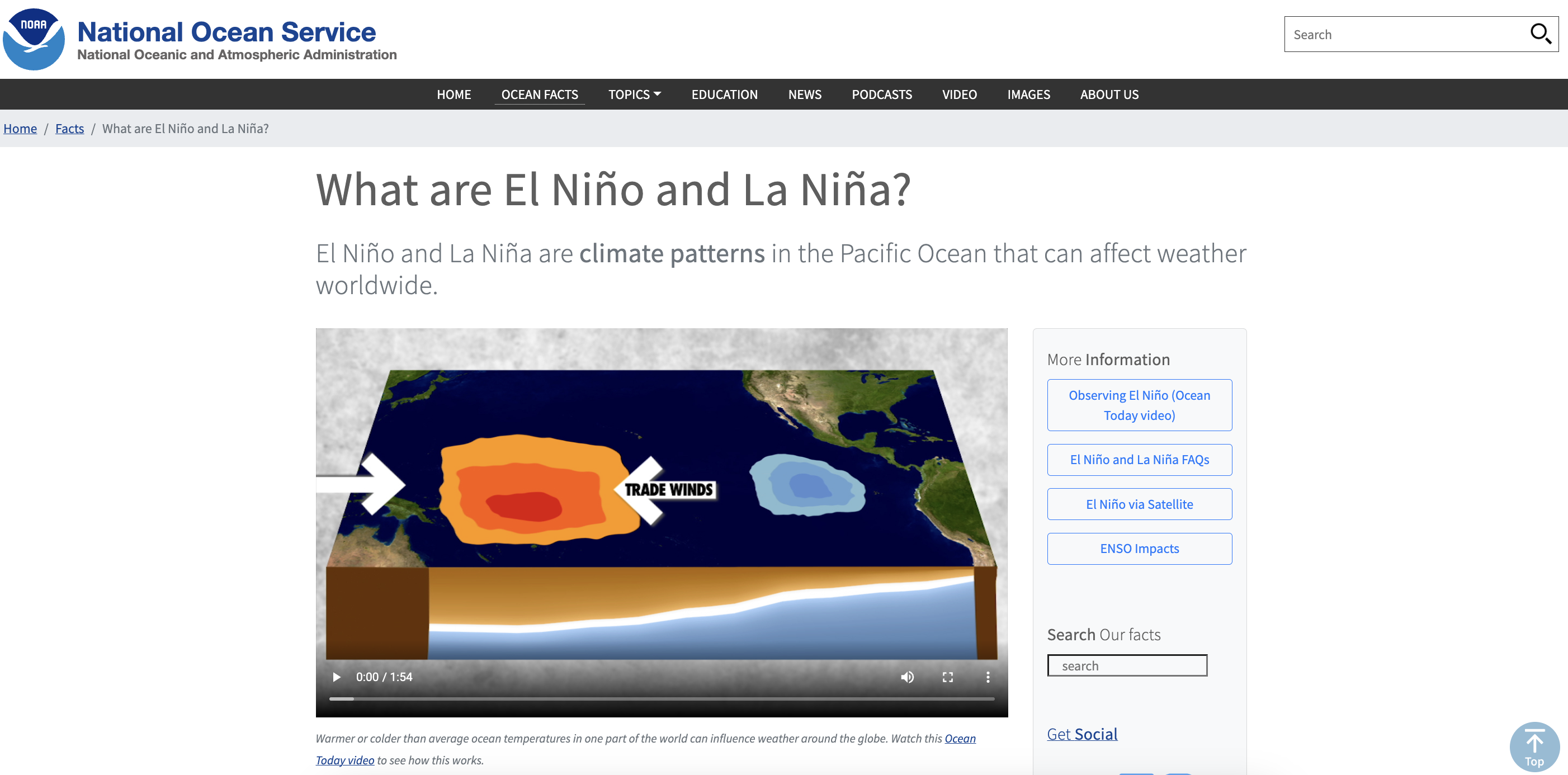
What are El Niño and La Niña?

Related Resources

What is Carbon Sequestration?
Carbon sequestration – the practice of removing carbon from the atmosphere and storing it – is one of the many approaches being taken to tackle climate change. Find out why this method is being us[...]
Why is pH Important?
pH is important for a wide range of industries from aquaculture to wastewater treatments that require an accurate pH reading, especially when it comes down to human safety. [...]
Marine Life Cycles
Although at the surface the ocean can appear calm and quiet, in fact there is an enormous amount of life activity taking place, particularly at certain times of the year. [...]
The Biological Productivity of the Ocean
Productivity fuels life in the ocean, drives its chemical cycles, and lowers atmospheric carbon dioxide. Nutrient uptake and export interact with circulation to yield distinct ocean regimes. [...]
Seagrasses, Nature’s Water Filter
In many systems, vegetated estuarine habitats such as salt marshes and seagrass beds act as a natural water filtration system—where sediment and nutrient-rich water flows in and cleaner water flows [...]
World’s first underwater climate strike calls for ocean protection
Young Mauritian scientist and climate advocate, Shaama Sandooyea, has held the world’s first ever underwater climate strike at the heart of the Indian Ocean. The protest took place at the Saya de Ma[...]
2020 Was One of Three Warmest Years on Record
The year 2020 was one of the three warmest on record, and rivalled 2016 for the top spot, according to a consolidation of five leading international datasets by the World Meteorological Organization ([...]
4 Charts Explain Greenhouse Gas Emissions by Countries and Sectors
Globally, greenhouse gas emissions have grown by 53% from 1990 to 2019. Where are these emissions coming from, and who is responsible? WRI’s Climate Watch platform offers comprehensive emissions dat[...]