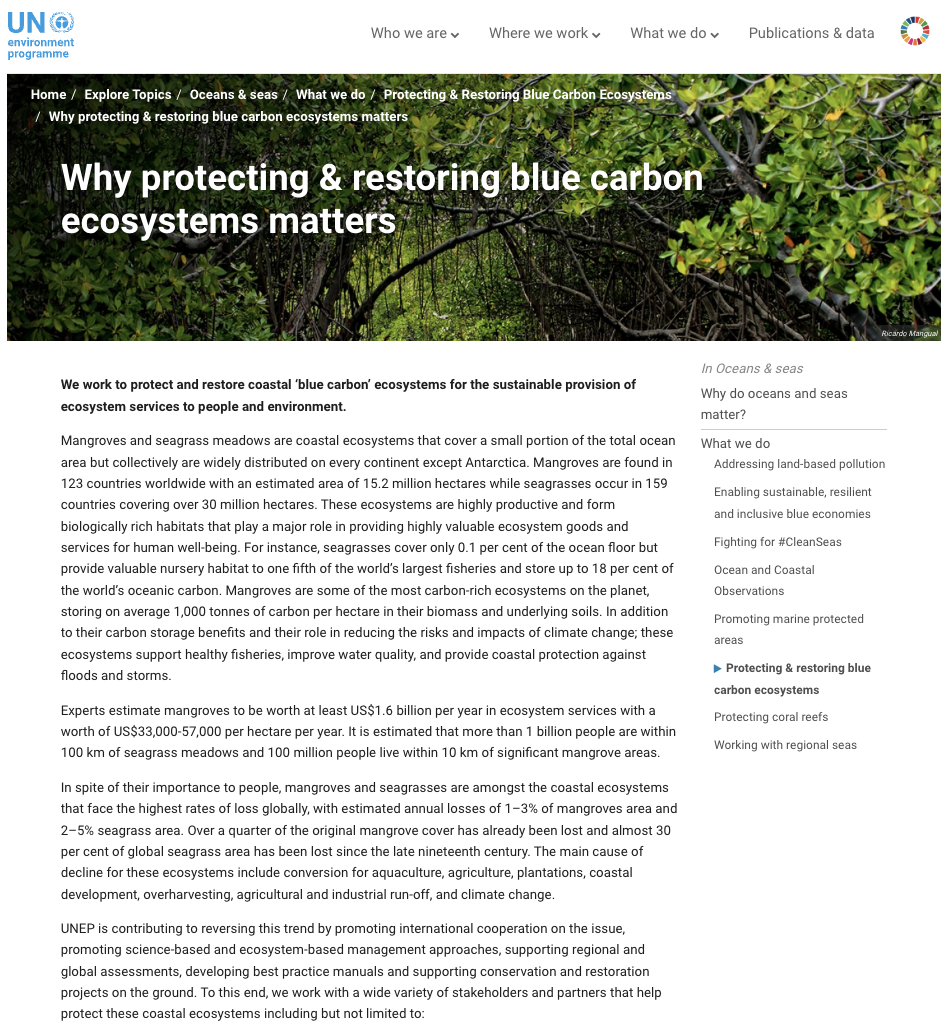
Why Protecting & Restoring Blue Carbon Ecosystems Matters

Related Resources

Seagrasses, Nature’s Water Filter
In many systems, vegetated estuarine habitats such as salt marshes and seagrass beds act as a natural water filtration system—where sediment and nutrient-rich water flows in and cleaner water flows [...]
What is Carbon Sequestration?
Carbon sequestration – the practice of removing carbon from the atmosphere and storing it – is one of the many approaches being taken to tackle climate change. Find out why this method is being us[...]
Why is pH Important?
pH is important for a wide range of industries from aquaculture to wastewater treatments that require an accurate pH reading, especially when it comes down to human safety. [...]
World’s first underwater climate strike calls for ocean protection
Young Mauritian scientist and climate advocate, Shaama Sandooyea, has held the world’s first ever underwater climate strike at the heart of the Indian Ocean. The protest took place at the Saya de Ma[...]
Understanding Blue Carbon
Blue carbon refers to carbon dioxide that is absorbed from the atmosphere and stored in the ocean. “Blue” refers to the watery nature of this storage. The vast majority of blue carbon is carbon di[...]
How Does CO2 Affect pH In Water?
The amount of carbon dioxide (CO2) in a solution is one of the many factors that determines the pH of water. When CO2 levels increase in water, the pH level drops, which makes the water become more ac[...]
A New Generation of Ocean Farmers are Reducing Pollution with Seaweed
Seaweed soaks up carbon and nitrogen, two pollutants lingering in the water. If ocean farmers devoted a little less than 5 percent of U.S. waters to growing seaweed, they could clean up an estimated 1[...]
This Interactive Chart Shows Changes in the World’s Top 10 Emitters
A lot has happened since countries met in Paris in 2015 and agreed on an accord to combat climate change. So far, 196 countries ratified or otherwise joined the Paris Climate Agreement, representing m[...]