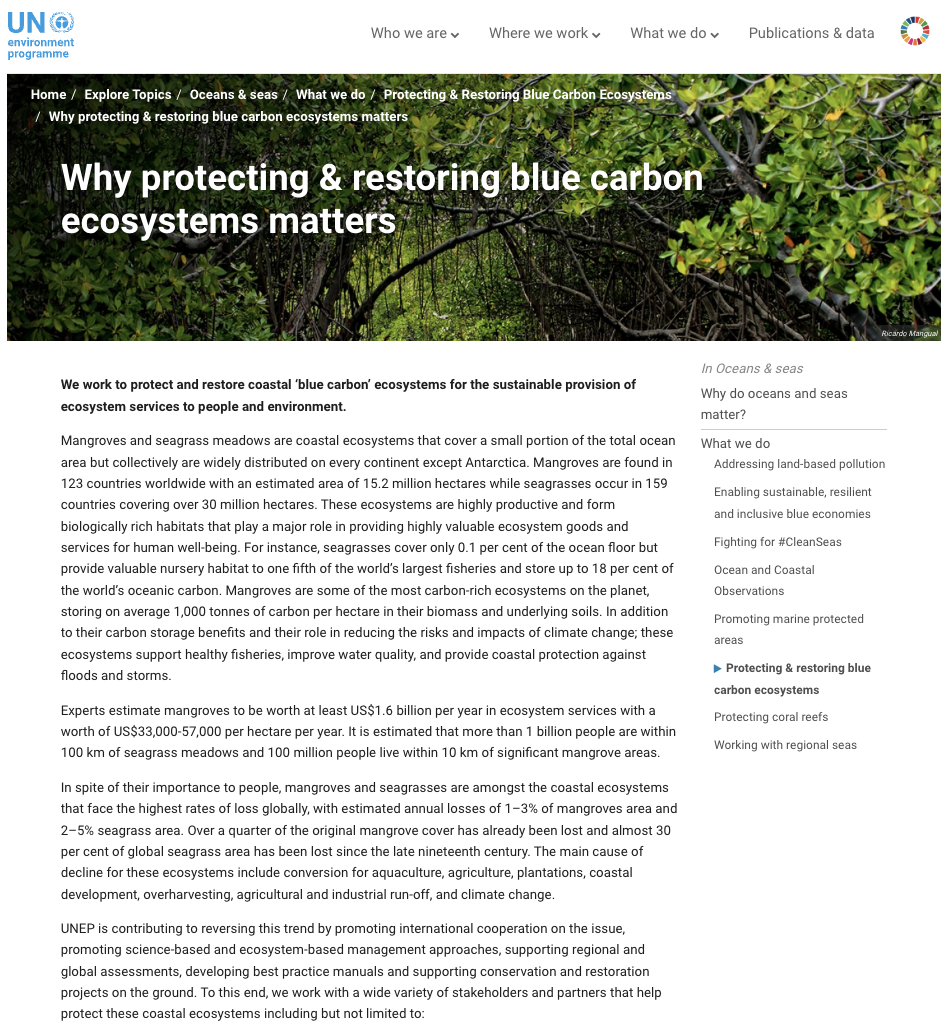
Why Protecting & Restoring Blue Carbon Ecosystems Matters

Related Resources

2020 Was One of Three Warmest Years on Record
The year 2020 was one of the three warmest on record, and rivalled 2016 for the top spot, according to a consolidation of five leading international datasets by the World Meteorological Organization ([...]
World’s first underwater climate strike calls for ocean protection
Young Mauritian scientist and climate advocate, Shaama Sandooyea, has held the world’s first ever underwater climate strike at the heart of the Indian Ocean. The protest took place at the Saya de Ma[...]
4 Charts Explain Greenhouse Gas Emissions by Countries and Sectors
Globally, greenhouse gas emissions have grown by 53% from 1990 to 2019. Where are these emissions coming from, and who is responsible? WRI’s Climate Watch platform offers comprehensive emissions dat[...]
Understanding Blue Carbon
Blue carbon refers to carbon dioxide that is absorbed from the atmosphere and stored in the ocean. “Blue” refers to the watery nature of this storage. The vast majority of blue carbon is carbon di[...]
A New Generation of Ocean Farmers are Reducing Pollution with Seaweed
Seaweed soaks up carbon and nitrogen, two pollutants lingering in the water. If ocean farmers devoted a little less than 5 percent of U.S. waters to growing seaweed, they could clean up an estimated 1[...]
Why is pH Important?
pH is important for a wide range of industries from aquaculture to wastewater treatments that require an accurate pH reading, especially when it comes down to human safety. [...]
Provisioning and Supporting Services of Mangroves
There are a number of tangible products that can be directly utilised and marketed from mangrove forests. [...]
The Biological Productivity of the Ocean
Productivity fuels life in the ocean, drives its chemical cycles, and lowers atmospheric carbon dioxide. Nutrient uptake and export interact with circulation to yield distinct ocean regimes. [...]