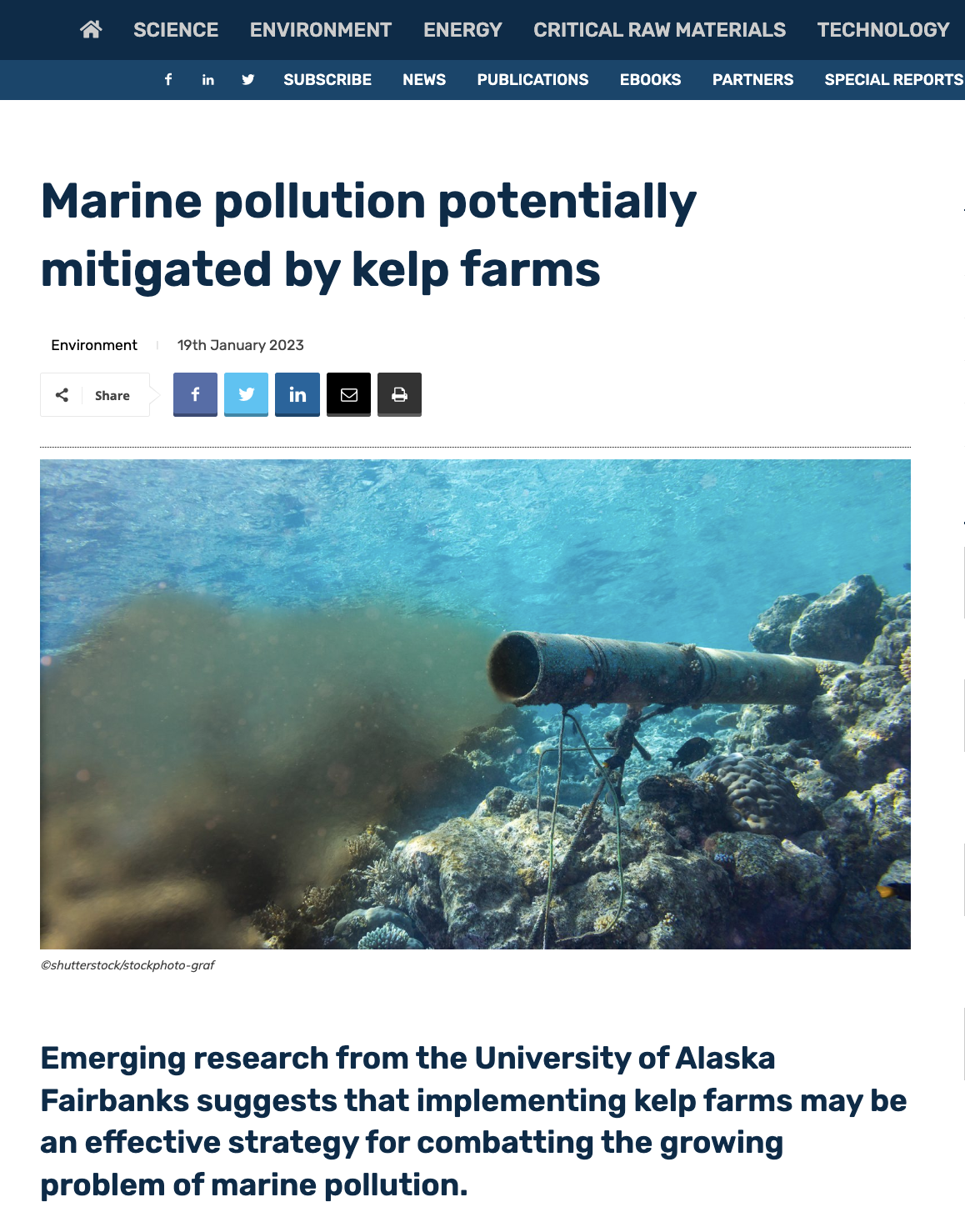
Marine Pollution Potentially Mitigated by Kelp Farms

Related Resources

What are El Niño and La Niña?
El Niño and La Niña are climate patterns in the Pacific Ocean that can affect weather worldwide and can also have global impacts on weather, wildfires, ecosystems, and economies. [...]
What are Mangrove Forests?
Mangroves are shrubs and trees that grow in coastal waters. Mangroves are halophytes, meaning they are salt-tolerant trees that thrive in intertidal conditions. These diverse and productive ecosystems[...]
What Is Blue Carbon and Why Does It Matter?
Though terrestrial forests typically get most of the attention, they are not the only ecosystems that possess a natural ability to fight climate change. There are three coastal ecosystems that are als[...]
Seagrasses, Nature’s Water Filter
In many systems, vegetated estuarine habitats such as salt marshes and seagrass beds act as a natural water filtration system—where sediment and nutrient-rich water flows in and cleaner water flows [...]
What is Carbon Sequestration?
Carbon sequestration – the practice of removing carbon from the atmosphere and storing it – is one of the many approaches being taken to tackle climate change. Find out why this method is being us[...]
Kelp Deforestation: Threats to our Underwater Forests
Kelp forests are some of the most dynamic and ecologically productive marine habitats in the world. A root-like system called a holdfast affixes to the rocky seafloor, supporting a long stipe that ext[...]
The Biological Productivity of the Ocean
Productivity fuels life in the ocean, drives its chemical cycles, and lowers atmospheric carbon dioxide. Nutrient uptake and export interact with circulation to yield distinct ocean regimes. [...]
World’s first underwater climate strike calls for ocean protection
Young Mauritian scientist and climate advocate, Shaama Sandooyea, has held the world’s first ever underwater climate strike at the heart of the Indian Ocean. The protest took place at the Saya de Ma[...]